

Introduction
Aluminium sunroom roof beams are strong. They are light. They last for many years. To choose the right beam, you need to know its physical properties. In Europe, these properties follow clear standards. The main ones are EN 755 for mechanical properties and EN 573 for chemical composition. EN 1999 (Eurocode 9) covers structural design.
This article explains the key physical properties. It uses simple language. It follows European standard formats. It also includes a FAQ section. So you can find answers fast.
Alummira is a trusted aluminium profile supplier. We have 10 years of experience in aluminium profile design. We also have strong international trade experience. Our team serves customers worldwide. We help you pick the right alloy for your sunroom project.
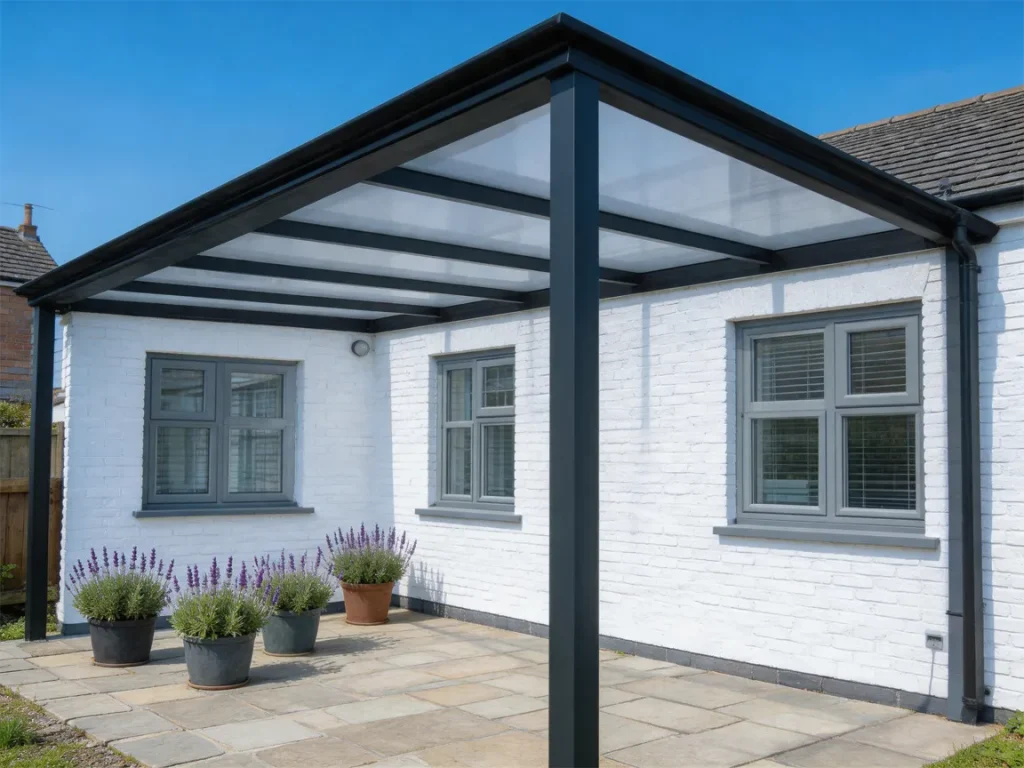
1. What Is an Aluminium Sunroom Roof Beam?
A sunroom roof beam is a structural profile. It sits on top of walls or posts. It holds the roof. It carries snow, wind, and its own weight. Most beams are made from extruded aluminium. Extrusion shapes the metal into long, strong profiles.
The beam must resist bending. It must not sag too much. It must handle temperature changes. So the alloy and temper matter a lot.
2. Main European Standards for Aluminium Beams
Three standards are most important.
EN 755 – Mechanical Properties
EN 755-2 specifies mechanical property limits. These come from tensile testing. They apply to extruded rod, bar, tube, and profiles. This standard gives values for tensile strength, yield strength, and elongation. It covers many alloys. Each alloy has its own table.
EN 573 – Chemical Composition
EN 573-3 defines the chemical composition of wrought aluminium alloys. It lists the minimum and maximum content for each element. For example, alloy 6063 contains silicon (0.20–0.60%), magnesium (0.45–0.90%), and iron (max 0.35%). Alloy 6061 has more magnesium and some copper.
EN 1999 (Eurocode 9) – Structural Design
Eurocode 9 gives design rules for aluminium structures. It covers bending, compression, and deflection. It provides the 0.2% proof strength (f₀) and ultimate tensile strength (fᵤ) for design. It also includes partial safety factors.
3. Key Physical Properties of Aluminium Roof Beams
3.1 Density
Aluminium is light. Its density is about 2,700 kg/m³. This is roughly one-third of steel. So the beam is easy to handle. It puts less load on the building.
3.2 Young’s Modulus (Elastic Modulus)
For alloy 6063-T6, Young’s modulus is about 70,000 MPa. This value shows stiffness. A higher modulus means less bending under load. Aluminium’s modulus is about one-third of steel’s. So aluminium beams need deeper sections to match steel stiffness.
3.3 Poisson’s Ratio
Poisson’s ratio for aluminium is about 0.33. This number shows how the material expands sideways when compressed. It is useful for detailed stress analysis.
3.4 Coefficient of Thermal Expansion
Aluminium expands when heated. Its thermal expansion coefficient is about 23 × 10⁻⁶ per °C. This is higher than steel. So sunroom beams need room to expand. Designers often use slotted holes or flexible connections.
3.5 Thermal Conductivity
Aluminium conducts heat well. Thermal conductivity is around 200 W/(m·K) for many alloys. This means the beam can transfer heat. In cold climates, thermal breaks may be needed. They stop heat loss through the beam.
3.6 Mechanical Strength
Strength depends on alloy and temper. Alloy 6063-T6 is common for sunroom beams. Here are typical values:
| Property | Value |
|---|---|
| 0.2% Proof Strength (f₀) | 170 MPa |
| Ultimate Tensile Strength (fᵤ) | 205 MPa |
| Elongation | 10% |
These values come from EN 1999-1-1 tables. They apply to unwelded profiles with thickness up to 25 mm.
Alloy 6061-T6 is stronger. Its proof strength is about 240 MPa. Its ultimate strength is about 260 MPa. It is used for longer spans or heavier loads.
3.7 Deflection Limits
Deflection is how much the beam sags. Eurocode 9 gives limits. For roof beams, a common limit is L/200 under dead load. For all loads combined, the limit is L/100. “L” is the span length. So a 3-meter beam should not sag more than 15 mm under full load.
4. Which Alloy Should You Use?
Two alloys are most common for sunroom roof beams.
6063-T6 is the standard choice. It has good strength. It extrudes well. It gives a smooth surface. It works for most residential sunrooms.
6061-T6 is stronger. It is better for large spans. It also welds well. But it is harder to extrude. So it costs more.
At Alummira, we supply both alloys. We also stock 6005, 6082, and other grades. Our 10-year design experience helps you match the alloy to your project. Our international trade team ships worldwide. We handle customs, packing, and delivery. So you get your profiles on time.
5. How to Check Beam Performance
You can check beam performance in three simple steps.
Step 1: Find the load. Add snow load, wind load, and dead load. Dead load includes the roof panels and the beam’s own weight.
Step 2: Calculate bending stress. Use the formula: stress = moment ÷ section modulus. Compare it to the proof strength. It must be lower.
Step 3: Check deflection. Use the formula: w = (5 × q × L⁴) ÷ (384 × E × I). Keep “w” below the limit. Eurocode 9 gives the limits.
If the beam fails, choose a deeper profile. Or use a stronger alloy. Or add more support points.
FAQ
Q1: What is the density of aluminium roof beams?
A: About 2,700 kg/m³. That is one-third of steel.
Q2: Which European standard covers mechanical properties?
A: EN 755-2. It gives tensile strength, yield strength, and elongation limits.
Q3: What alloy is best for sunroom roof beams?
A: 6063-T6 for most homes. 6061-T6 for longer spans or heavier loads.
Q4: How much can an aluminium beam deflect?
A: Eurocode 9 suggests L/200 under dead load. Under all loads, L/100 is common.
Q5: Does aluminium expand a lot in heat?
A: Yes. Its expansion coefficient is about 23 × 10⁻⁶ per °C. That is higher than steel. So allow for movement.
Q6: What is the proof strength of 6063-T6?
A: About 170 MPa. Ultimate strength is about 205 MPa.
Q7: Can Alummira help with custom profiles?
A: Yes. We have 10 years of design experience. We make custom dies. We ship worldwide.
Q8: What is Eurocode 9?
A: EN 1999. It is the European design code for aluminium structures.
Conclusion
Aluminium sunroom roof beams must meet clear physical standards. Density, modulus, strength, and deflection all matter. European standards like EN 755, EN 573, and EN 1999 give the rules. Alloy 6063-T6 works for most projects. Alloy 6061-T6 is better for heavy loads.
Alummira is your partner for aluminium profiles. We have 10 years of design experience. We have strong international trade skills. We deliver quality profiles that meet European standards. Contact us for your next sunroom project.