

Need custom aluminum profiles for your pergola?
Alummira can help.
We have 10 years of experience in custom aluminum extrusion.
Send your drawings.
We offer free consultation.
What Is a Secondary Beam?
An aluminum alloy pergola frame has main beams and secondary beams.
Main beams are the main load-bearing members.
They sit directly on the posts.
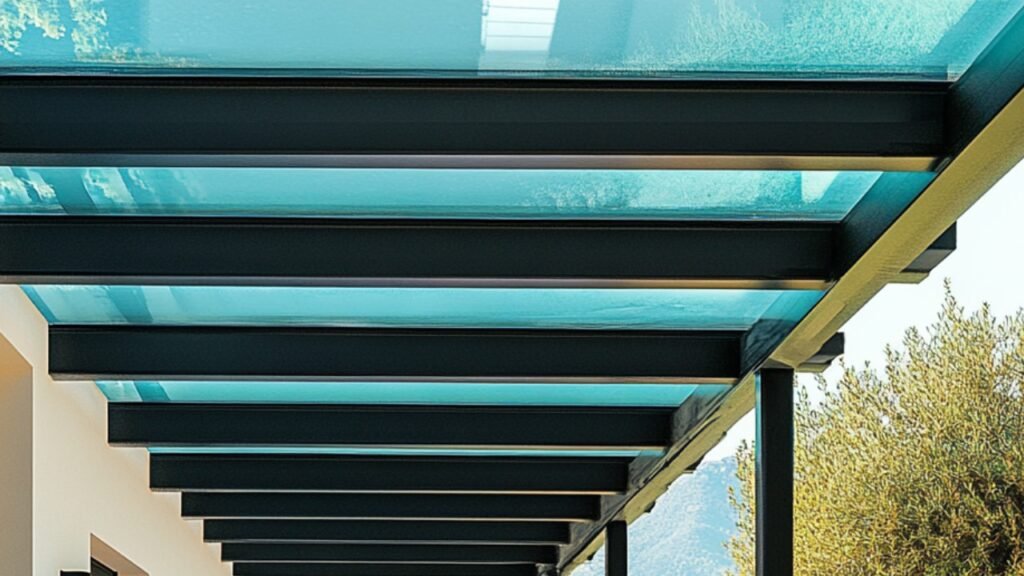
Secondary beams sit on top of the main beams.
They run perpendicular to the main beams.
Their job is to support the glass panels.
They transfer glass loads to the main beams.
The spacing of secondary beams sets the span of the glass panels.
If spacing is too large, glass deflects too much.
If spacing is too small, more material is used and cost rises.
Finding the right spacing and section is the core of secondary beam design.
Applicable European Standards
Design of aluminum alloy pergola secondary beams follows these standards:
| Standard No. | Content |
|---|---|
| EN 1999-1-1 | Design of aluminium structures — General rules |
| EN 1991-1-1 | Actions on structures — Self-weight and imposed loads |
| EN 1991-1-3 | Actions on structures — Snow loads |
| EN 1991-1-4 | Actions on structures — Wind actions |
| EN 1090-3 | Execution of aluminium structures — Technical requirements |
| EN 755-2 | Mechanical properties of extruded aluminium tube, bar and profiles |
| EN 573-3 | Chemical composition of aluminium and aluminium alloys |
EN 1999-1-1 is the basic reference for secondary beam resistance.
EN 1090-3 covers fabrication and installation quality.
Material Parameters
The most common alloy for secondary beams is 6063-T6.
This material extrudes well.
It has moderate strength.
It is suitable for pergola members.
According to Eurocode 9, the basic material parameters for 6063-T6 are:
| Parameter | Value |
|---|---|
| Elastic modulus E | 70 GPa |
| Density ρ | 2700 kg/m³ |
| Poisson’s ratio ν | 0.3 |
| 0.2% proof strength f₀ | 160 MPa |
| Ultimate tensile strength fᵤ | 195 MPa |
| Yield-to-tensile ratio | 0.82 |
Partial factors follow EN 1999: γ_M1 = 1.10 for section resistance, γ_M2 = 1.25 for tensile fracture.
Some manufacturers use 6063-T66.
Its ultimate tensile strength is not less than 215 N/mm².
Its wall thickness range is 3.0 to 5.0 mm.
T66 has slightly higher strength than T6.
It also costs a little more.
Loads on Secondary Beams
Secondary beams carry three types of load.
Dead load.
The main dead load comes from the glass panels.
4+4 mm tempered laminated glass weighs about 20 kg/m².
That is 0.20 kN/m².
If secondary beam spacing is 0.8 m, each meter of secondary beam carries 0.16 kN/m of glass dead load.
Add the beam self-weight and gaskets.
Total dead load is about 0.20 kN/m.
Snow load.
Snow load follows EN 1991-1-3.
In most of Europe, the standard snow load s₀ is between 0.5 and 0.75 kN/m².
Pergola roofs usually have a slope below 30°.
So snow load is not reduced.
Take the glass roof snow load as 0.75 kN/m².
Multiply by secondary beam spacing of 0.8 m.
Each meter of secondary beam carries 0.60 kN/m of snow load.
Wind load.
Wind load follows EN 1991-1-4.
For an open pergola, the roof gets net pressure.
This can be uplift or downward pressure.
Basic wind pressure depends on the region.
It is usually between 0.5 and 0.9 kN/m².
The shape coefficient c_f for the roof is about 1.5.
Use the project wind zone to get exact values.
For load combinations, use ultimate limit state: 1.35 × dead load + 1.5 × snow load, or 1.5 × wind load.
Take the larger value.
For serviceability limit state, use 1.0 × dead load + 1.0 × snow load, or 1.0 × wind load.
Deflection Limit
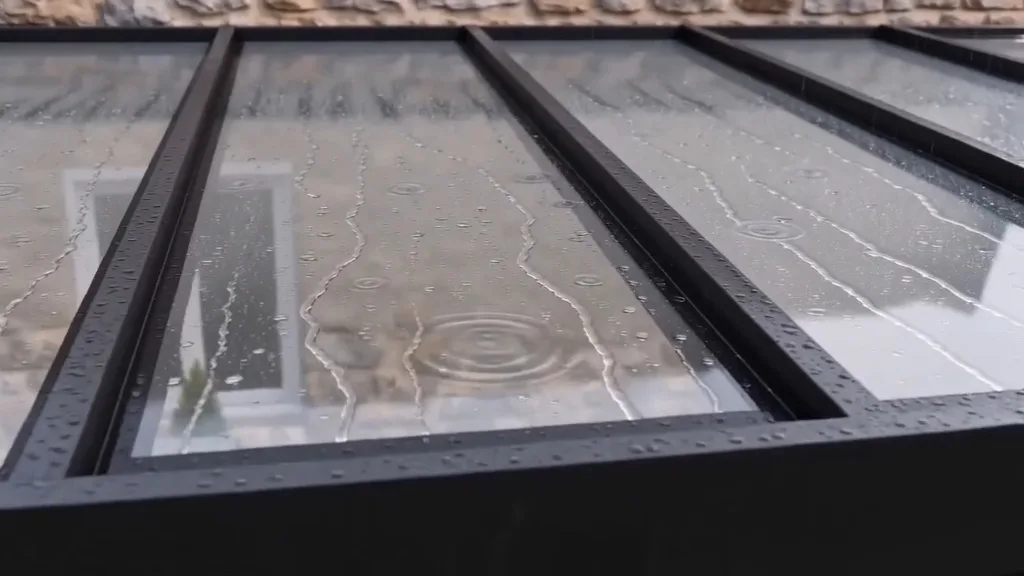
This is the most critical check in secondary beam design.
Glass is a brittle material.
If the beam deflects too much, the glass may crack.
EN 1999-1-1 recommends L/360 for beams supporting brittle finishes.
This limit is suitable for pergola secondary beams.
The glass panel has low tolerance for deformation.
So the secondary beam must be stiff enough.
Some manufacturers use L/200 to simplify design.
But 4+4 mm glass is thin.
It is better to use L/360.
Recommended Section Parameters
The table below lists common secondary beam sections.
They apply to 6063-T6 aluminum alloy.
Glass load is 0.20 kN/m².
Snow load is 0.75 kN/m².
| Section model | Width × Height (mm) | Wall thickness (mm) | Moment of inertia I_y (cm⁴) | Section modulus W_y (cm³) | Maximum span (mm) | Suitable secondary beam spacing (mm) |
|---|---|---|---|---|---|---|
| AL-6040 | 60×40 | 2.5 | 18.2 | 9.1 | 1500 | ≤800 |
| AL-8040 | 80×40 | 3.0 | 33.5 | 16.8 | 1800 | ≤900 |
| AL-8050 | 80×50 | 3.0 | 52.1 | 20.8 | 2200 | ≤1000 |
| AL-10050 | 100×50 | 3.0 | 85.4 | 34.2 | 2600 | ≤1000 |
| AL-10060 | 100×60 | 4.0 | 126.0 | 42.0 | 3000 | ≤1200 |
The spans in the table are maximum allowable values under simply supported conditions.
They are checked by both L/360 deflection control and stress control at 0.6 times yield strength.
If the secondary beam spacing is larger, choose a larger section.
Section properties vary by manufacturer.
The data above is for reference only.
Actual design should use the section properties provided by the manufacturer.
Secondary Beam Spacing
The choice of secondary beam spacing depends on two factors.
One is the span capacity of the glass panel.
The other is the capacity of the secondary beam itself.
4+4 mm tempered laminated glass under uniform load usually has an allowable span between 600 and 900 mm.
Common secondary beam spacings are 600 mm, 800 mm, and 1000 mm.
Smaller spacing makes the glass safer.
But it increases the number of secondary beams.
A spacing of 800 mm is generally recommended.
It balances safety and cost.
There is some engineering experience data for reference.
Main beam spacing should not exceed 3500 mm.
Secondary beam spacing should not exceed 1250 mm.
Beyond this range, aluminum connections may show small deformation.
Strong wind may also cause noise.
Connection Requirements
There are two main connection methods between secondary beams and main beams: bolted connections and bracket connections.
For bolted connections, use stainless steel bolts.
According to EN 1090-3, connections between aluminum members should use A2 or A4 stainless steel.
M8 or M10 bolts are recommended.
The clearance between the bolt hole and the bolt should not exceed 1 mm.
Use isolation gaskets at the connection.
This prevents galvanic corrosion between stainless steel and aluminum.
This is an issue that is often overlooked in aluminum structure installation.
If welding is used, the weld thickness should not be less than 1.5 mm.
The heat-affected zone loses strength after welding.
So the area near the weld should not be the highest stress region.
FAQ
Q1: How much does 4+4 tempered glass weigh per square meter?
A: 4+4 mm tempered laminated glass weighs about 20 kg/m².
The calculation is: total glass thickness 8 mm × glass density 2.5 kg/(m²·mm).
The PVB interlayer weight is very small.
It can be ignored.
Q2: What is the maximum span of a secondary beam?
A: It depends on the section size and the load.
For an 80×50×3.0 mm 6063-T6 profile, with secondary beam spacing of 800 mm and snow load of 0.75 kN/m², the maximum span is about 2200 mm.
If a larger span is needed, choose a 100×50 or larger section.
Q3: What spacing should be used for secondary beams?
A: 800 mm is recommended.
At this spacing, the span of 4+4 mm glass is moderate.
Both strength and stiffness meet requirements.
If spacing is over 1000 mm, the glass may deflect too much under snow load.
If spacing is under 600 mm, too many secondary beams are used.
It is not economical.
Q4: What is the difference between 6063-T6 and 6063-T66?
A: Both T6 and T66 are artificial aging states.
T66 has slightly higher strength.
The ultimate tensile strength of 6063-T66 is not less than 215 N/mm².
T6 has an ultimate tensile strength of 195 MPa.
Both can be used for pergola secondary beams.
T6 is more common.
It is easier to supply.
Q5: Do secondary beams need anti-corrosion treatment?
A: Yes.
Aluminum alloy is corrosion resistant.
But for outdoor use, anodizing or powder coating is recommended.
The anodized film thickness should be not less than 10 μm.
If the pergola is in a coastal area, the film thickness should be not less than 15 μm.
Q6: What deflection limit should be used for secondary beams?
A: L/360 is recommended.
This is the value recommended by EN 1999-1-1 for beams supporting brittle finishes.
Glass is brittle.
Too much deflection causes stress concentration in the glass.
L/200 is only suitable for beams supporting non-brittle finishes.
Q7: How should secondary beams connect to main beams?
A: Stainless steel bolts plus isolation gaskets are recommended.
Use M8 or M10 bolts.
Use a 1 mm thick nylon or PTFE gasket at the connection.
This breaks the galvanic corrosion path between aluminum and stainless steel.
Do not fasten stainless steel bolts directly to aluminum without isolation.
Q8: Which European countries have the highest snow loads?
A: The Nordic countries have the highest snow loads.
In Finland, Norway, and northern Sweden, the standard snow load can reach 1.5 to 2.5 kN/m².
In Central Europe, such as Germany, Belgium, and the Netherlands, the standard snow load is usually 0.5 to 0.75 kN/m².
In Southern Europe, such as most of Italy and Spain, snow load is lower, between 0.3 and 0.5 kN/m².
When designing secondary beams, use the national annex for the project location.
Q9: Can Alummira customize aluminum secondary beams?
A: Yes.
Alummira has 10 years of experience in custom aluminum profiles.
We can produce secondary beams to your drawing.
Send your drawings for a free consultation.
We will review your section, alloy, and finish.
Need Custom Aluminum Profiles?
Alummira has 10 years of experience in custom aluminum extrusion.
We support pergola secondary beams, main beams, and full frame systems.
Send your drawings.
We offer free consultation.
Let us help you turn your design into a real product.